


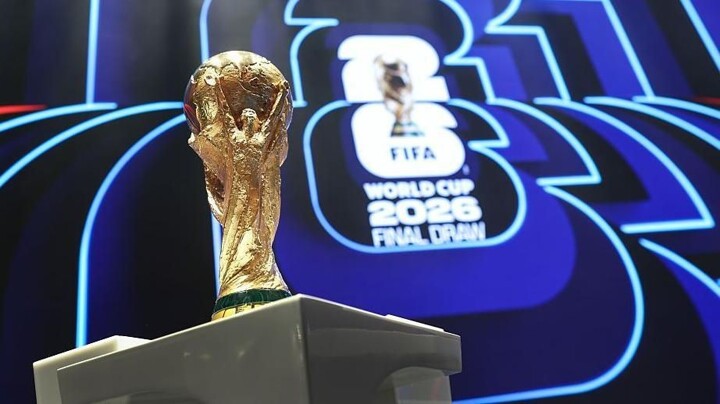
The World Cup 2026 draw has finished and All Football brings you the complete draw results:
 Group A: Mexico, South Africa, Korea Republic, European Play-Off D
Group B: Canada, European Play-Off A, Qatar, Switzerland
Group C: Brazil, Morocco, Haiti, Scotland
Group D: USA, Paraguay, Australia, European Play-Off C
Group E: Germany, Curacao, Côte d'Ivoire, Ecuador
Group F: Netherlands, Japan, European Play-Off B, Tunisia
Group G: Belgium, Egypt, IR Iran, New Zealand
Group H: Spain, Cabo Verde, Saudi Arabia, Uruguay
Group I: France, Senegal, Play-Off Tournament 2, Norway
Group J: Argentina, Algeria, Austria, Jordan
Group K: Portugal, Play-Off Tournament 1, Uzbekistan, Colombia
Group L: England, Croatia, Ghana, Panama
Six of the 48 teams at World Cup 2026 have yet to be determined, and will only be known in March 2026.
Four will come from the 16-team UEFA play-offs, which will be contested by Albania, Bosnia and Herzegovina, Czechia, Denmark, Italy, Kosovo, Northern Ireland, North Macedonia, Poland, Republic of Ireland, Romania, Slovakia, Sweden, Türkiye, Ukraine and Wales.
The other two spots will be contested by six teams - Bolivia, Congo DR, Iraq, Jamaica, New Caledonia and Suriname - at the Play-Off Tournament
Sure!
Below is the same content with all-new headings and no bullet formatting anywhere.
Structure is clean, paragraphs only.
The Structure of the 2026 World Cup Draw
The 2026 World Cup is drawing closer, and with the tournament expanded to forty-eight teams, understanding the draw format has never been more important. Hosted jointly by the United States, Canada and Mexico, the competition begins on June 11, 2026. Before that, the official Final Draw will reveal every group and shape the potential knockout paths.
The Group Model Adopted by FIFA
Although FIFA first explored a format that created sixteen groups of three nations each, this idea was eventually abandoned. The final decision returned to a more traditional shape. The tournament will feature twelve groups, each containing four teams. This offers the same basic rhythm as past editions: a mini-league format with meaningful matches and a clear route to the knockout rounds.
The Method Behind the Team Allocation
All forty-eight nations in the tournament are placed into four distinct pots. Each pot contains twelve teams. The official FIFA Men’s World Ranking is the key reference for determining which nation sits in which pot. Host teams also receive automatic placement privileges and cannot be moved into any other location during the draw.
Examples of Teams Participating in the Draw
The draw pool includes representatives from every confederation. There are nations from CONCACAF such as Canada, Mexico, the United States, Haiti, Panama and Curaçao. From the AFC region appear Australia, Iran, Japan, Jordan, Qatar, Saudi Arabia, South Korea and Uzbekistan. African representation includes Algeria, Cape Verde, Egypt, Ghana, Ivory Coast, Morocco, Senegal, South Africa and Tunisia. South American qualifiers include Argentina, Brazil, Colombia, Ecuador, Paraguay and Uruguay. New Zealand arrives from the OFC. Europe contributes England, France, Croatia, Portugal, Norway, the Netherlands, Germany, Austria, Scotland, Switzerland, Spain and Belgium.
Process of Forming the Twelve Groups
The mechanics of the draw are simple in structure. One team from each pot will be placed into every group, ensuring that all twelve groups hold four nations. The placement sequence always respects FIFA’s ranking and eligibility rules to avoid conflicts.
Rules That Shape the Draw Outcome
Several restrictions are mandatory in the formation of each group. Teams from the same confederation are not allowed to be paired together at the group stage. However, European sides have a special exception: at least one European team must appear in every group, and no more than two are permitted in the same group. The three co-hosts are fixed into predetermined groups for logistical reasons. Mexico is assigned to Group A, Canada to Group B and the United States to Group D.
Competitive Balance in the Knockout Path
FIFA has introduced a unique balance mechanism involving the top four non-host nations. Spain and Argentina will be placed on one side of the bracket, while France and England will occupy the opposite side. If all four nations win their respective groups, they will be prevented from meeting until the semifinal stage. Those placed on opposite sides cannot face each other until the final. Any slip in group position removes that protection entirely.
How Group Positions Are Assigned
When a team is drawn from a pot, it enters the first alphabetically available group that satisfies every restriction. A computer system manages this to ensure fairness. Unlike earlier World Cups, Pot One teams are not individually drawn into group positions. Instead, every nation in Pot One automatically takes the first position in each group. A predetermined grid later decides the internal arrangement of the remaining three teams.
A Simplified Understanding of the Entire Draw
The entire draw process can be described concisely. Four pots will be used, one nation from each pot will land in every group, the host nations remain fixed in their groups, confederations must be separated and the world’s elite sides are spread out intelligently. Everything else is an operational detail.
Official Pot List for the Draw
The confirmed pots for the 2026 tournament are based on seed number and current FIFA World Ranking. In Pot One appear the United States, Mexico, Canada, Spain, Argentina, France, England, Brazil, Portugal, the Netherlands, Belgium and Germany.
Pot Two includes Croatia, Morocco, Colombia, Uruguay, Switzerland, Japan, Senegal, Iran, South Korea, Ecuador, Austria and Australia.
Pot Three contains Norway, Panama, Egypt, Algeria, Scotland, Paraguay, Tunisia, Ivory Coast, Uzbekistan, Qatar, Saudi Arabia and South Africa.
Pot Four lists Jordan, Cape Verde, Ghana, Curaçao, Haiti, New Zealand, the four winners of UEFA Play-Off paths A, B, C and D along with the two winners of the Inter-Confederation Play-Offs.
The Reasoning Behind the Pot Distribution
The three host nations open Pot One automatically. They are then joined by the nine highest-ranked qualified teams according to the November 2025 FIFA Men’s World Rankings. Pots Two, Three and Four are then filled in strict descending ranking order. Although not every place is settled at draw time, the remaining six teams that will be decided in March 2026 playoffs are still assigned to Pot Four regardless of their eventual ranking position. This ensures structural consistency and prevents late confusion.

Sharing is caring
Your sharing is our biggest motivation to make the site better and update live links correctly. Share this with your football fan groups!